
How to Improve Your Local SEO Rankings and Attract More Nearby Customers
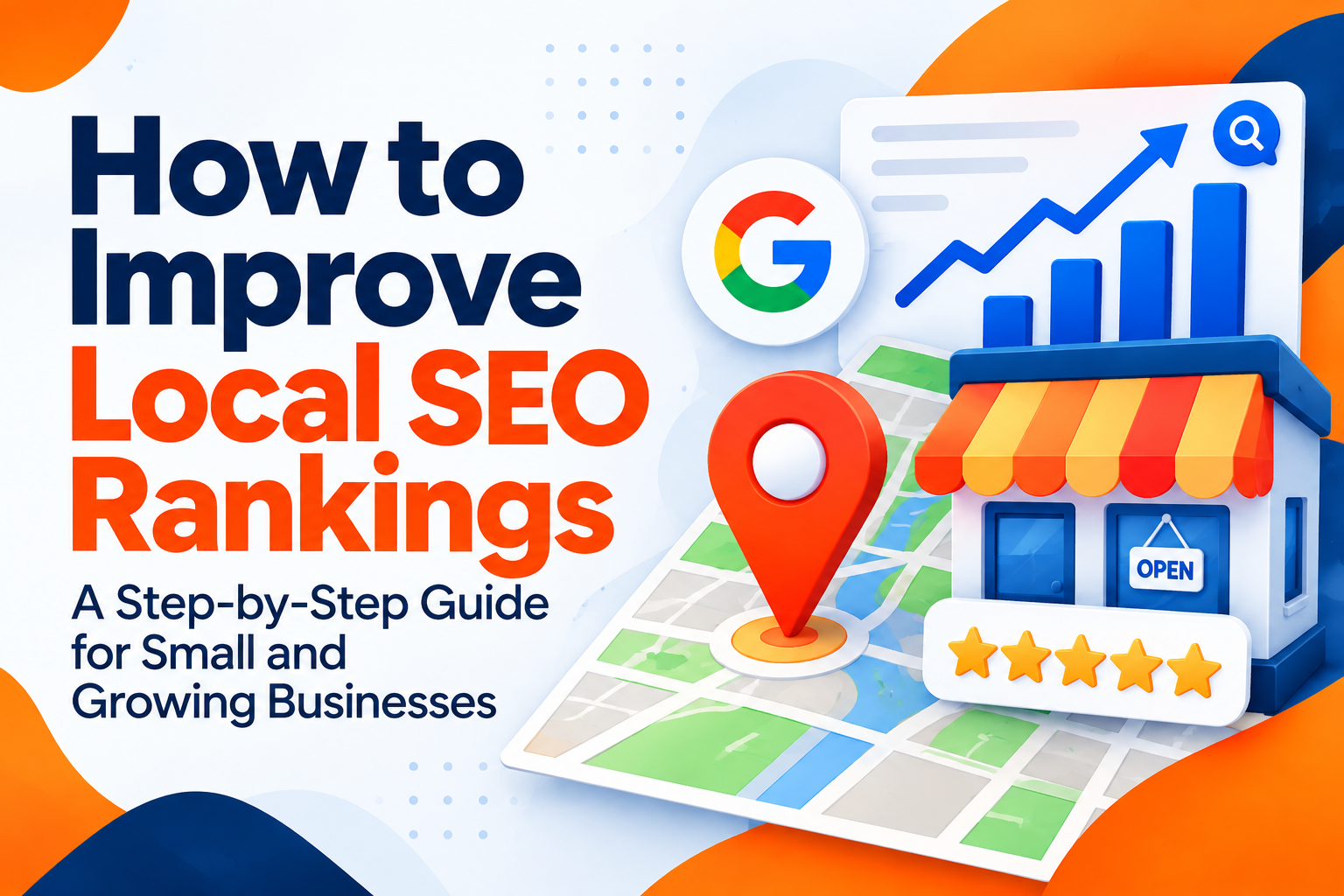
Local SEO helps nearby or location-specific customers discover a business when they search for relevant services. Sustainable improvement comes from accurate business information, useful local pages, authentic reviews, relevant mentions, strong service content and an easy mobile experience.
Local SEO Growth Framework
| Area | Goal |
|---|---|
| Business profile | Accurate, complete information |
| Website | Relevant local service content |
| Reviews | Authentic customer feedback |
| Mentions/links | Legitimate local authority |
| UX | Easy calls, bookings and forms |
1. Build an Accurate Business Profile
Keep your core business details accurate and current. Choose categories that reflect what the business actually does and maintain current hours, website, phone and other applicable information.
How to investigate: build an accurate business profile
Choose the smallest useful correction. Explain the problem in plain language to the person responsible for the website. Separate urgent failures that prevent visitors or crawlers from using the page from optional enhancements. In a WordPress environment, check whether the change belongs in Rank Math, the theme, a plugin, hosting, page content or the underlying business process; changing an unrelated setting will not address the cause.
Validate the result. Retest the same URL and user journey after implementation. Compare with the saved baseline and look for unintended side effects, especially on mobile. Record the change date and continue monitoring the metric that originally exposed the problem. This method is more reliable than treating a single tool score as proof that the issue has been solved.
2. Create Strong Local Landing Pages
A useful location page should explain services, service area, customer needs, contact options and locally relevant information. Avoid mass-producing city pages with nearly identical text.
How to investigate: create strong local landing pages
Choose the smallest useful correction. Explain the problem in plain language to the person responsible for the website. Separate urgent failures that prevent visitors or crawlers from using the page from optional enhancements. In a WordPress environment, check whether the change belongs in Rank Math, the theme, a plugin, hosting, page content or the underlying business process; changing an unrelated setting will not address the cause.
Validate the result. Retest the same URL and user journey after implementation. Compare with the saved baseline and look for unintended side effects, especially on mobile. Record the change date and continue monitoring the metric that originally exposed the problem. This method is more reliable than treating a single tool score as proof that the issue has been solved.
3. Strengthen On-Page Local Signals
Use location information naturally in titles, headings, body copy and contact information when it genuinely describes the page. Do not stuff city names into every sentence.
How to investigate: strengthen on-page local signals
Choose the smallest useful correction. Explain the problem in plain language to the person responsible for the website. Separate urgent failures that prevent visitors or crawlers from using the page from optional enhancements. In a WordPress environment, check whether the change belongs in Rank Math, the theme, a plugin, hosting, page content or the underlying business process; changing an unrelated setting will not address the cause.
Validate the result. Retest the same URL and user journey after implementation. Compare with the saved baseline and look for unintended side effects, especially on mobile. Record the change date and continue monitoring the metric that originally exposed the problem. This method is more reliable than treating a single tool score as proof that the issue has been solved.
4. Improve Reviews Ethically
Ask real customers for honest reviews using compliant methods. Respond professionally and do not buy, gate or fabricate reviews.
How to investigate: improve reviews ethically
Choose the smallest useful correction. Explain the problem in plain language to the person responsible for the website. Separate urgent failures that prevent visitors or crawlers from using the page from optional enhancements. In a WordPress environment, check whether the change belongs in Rank Math, the theme, a plugin, hosting, page content or the underlying business process; changing an unrelated setting will not address the cause.
Validate the result. Retest the same URL and user journey after implementation. Compare with the saved baseline and look for unintended side effects, especially on mobile. Record the change date and continue monitoring the metric that originally exposed the problem. This method is more reliable than treating a single tool score as proof that the issue has been solved.
5. Keep Business Information Consistent
Correct old addresses, phone numbers, business names and duplicate listings across important platforms and directories.
How to investigate: keep business information consistent
Choose the smallest useful correction. Explain the problem in plain language to the person responsible for the website. Separate urgent failures that prevent visitors or crawlers from using the page from optional enhancements. In a WordPress environment, check whether the change belongs in Rank Math, the theme, a plugin, hosting, page content or the underlying business process; changing an unrelated setting will not address the cause.
Validate the result. Retest the same URL and user journey after implementation. Compare with the saved baseline and look for unintended side effects, especially on mobile. Record the change date and continue monitoring the metric that originally exposed the problem. This method is more reliable than treating a single tool score as proof that the issue has been solved.
6. Earn Relevant Local Mentions
Real local relationships can lead to useful mentions from chambers, associations, suppliers, events, community organizations and local media.
How to investigate: earn relevant local mentions
Choose the smallest useful correction. Explain the problem in plain language to the person responsible for the website. Separate urgent failures that prevent visitors or crawlers from using the page from optional enhancements. In a WordPress environment, check whether the change belongs in Rank Math, the theme, a plugin, hosting, page content or the underlying business process; changing an unrelated setting will not address the cause.
Validate the result. Retest the same URL and user journey after implementation. Compare with the saved baseline and look for unintended side effects, especially on mobile. Record the change date and continue monitoring the metric that originally exposed the problem. This method is more reliable than treating a single tool score as proof that the issue has been solved.
7. Add LocalBusiness Structured Data
Where appropriate, structured data can communicate business details such as name, address, phone, hours and URL. It should reflect visible, accurate information.
How to investigate: add localbusiness structured data
Choose the smallest useful correction. Explain the problem in plain language to the person responsible for the website. Separate urgent failures that prevent visitors or crawlers from using the page from optional enhancements. In a WordPress environment, check whether the change belongs in Rank Math, the theme, a plugin, hosting, page content or the underlying business process; changing an unrelated setting will not address the cause.
Validate the result. Retest the same URL and user journey after implementation. Compare with the saved baseline and look for unintended side effects, especially on mobile. Record the change date and continue monitoring the metric that originally exposed the problem. This method is more reliable than treating a single tool score as proof that the issue has been solved.
8. Improve Mobile Experience
Local searchers are often on phones. Make calling, directions, booking, forms, pricing information and navigation easy to use.
How to investigate: improve mobile experience
Choose the smallest useful correction. Explain the problem in plain language to the person responsible for the website. Separate urgent failures that prevent visitors or crawlers from using the page from optional enhancements. In a WordPress environment, check whether the change belongs in Rank Math, the theme, a plugin, hosting, page content or the underlying business process; changing an unrelated setting will not address the cause.
Validate the result. Retest the same URL and user journey after implementation. Compare with the saved baseline and look for unintended side effects, especially on mobile. Record the change date and continue monitoring the metric that originally exposed the problem. This method is more reliable than treating a single tool score as proof that the issue has been solved.
9. Create Locally Useful Content
Answer real local customer questions: service availability, delivery zones, appointment processes, local requirements, seasonal considerations, or neighborhood-specific information when relevant.
How to investigate: create locally useful content
Choose the smallest useful correction. Explain the problem in plain language to the person responsible for the website. Separate urgent failures that prevent visitors or crawlers from using the page from optional enhancements. In a WordPress environment, check whether the change belongs in Rank Math, the theme, a plugin, hosting, page content or the underlying business process; changing an unrelated setting will not address the cause.
Validate the result. Retest the same URL and user journey after implementation. Compare with the saved baseline and look for unintended side effects, especially on mobile. Record the change date and continue monitoring the metric that originally exposed the problem. This method is more reliable than treating a single tool score as proof that the issue has been solved.
10. Build Topic Authority Around Services
Support local landing pages with detailed service guides, FAQs, comparisons and educational content. Internal links can connect these resources.
How to investigate: build topic authority around services
Choose the smallest useful correction. Explain the problem in plain language to the person responsible for the website. Separate urgent failures that prevent visitors or crawlers from using the page from optional enhancements. In a WordPress environment, check whether the change belongs in Rank Math, the theme, a plugin, hosting, page content or the underlying business process; changing an unrelated setting will not address the cause.
Validate the result. Retest the same URL and user journey after implementation. Compare with the saved baseline and look for unintended side effects, especially on mobile. Record the change date and continue monitoring the metric that originally exposed the problem. This method is more reliable than treating a single tool score as proof that the issue has been solved.
11. Track Local Outcomes
Measure calls, bookings, forms, directions, organic landing-page performance and qualified leads where your tools permit.
How to investigate: track local outcomes
Choose the smallest useful correction. Explain the problem in plain language to the person responsible for the website. Separate urgent failures that prevent visitors or crawlers from using the page from optional enhancements. In a WordPress environment, check whether the change belongs in Rank Math, the theme, a plugin, hosting, page content or the underlying business process; changing an unrelated setting will not address the cause.
Validate the result. Retest the same URL and user journey after implementation. Compare with the saved baseline and look for unintended side effects, especially on mobile. Record the change date and continue monitoring the metric that originally exposed the problem. This method is more reliable than treating a single tool score as proof that the issue has been solved.
12. Maintain the System
Update hours, photos, services, staff details, location information and website content when they change. Local SEO is ongoing business-information maintenance as much as it is optimization.
How to investigate: maintain the system
Choose the smallest useful correction. Explain the problem in plain language to the person responsible for the website. Separate urgent failures that prevent visitors or crawlers from using the page from optional enhancements. In a WordPress environment, check whether the change belongs in Rank Math, the theme, a plugin, hosting, page content or the underlying business process; changing an unrelated setting will not address the cause.
Validate the result. Retest the same URL and user journey after implementation. Compare with the saved baseline and look for unintended side effects, especially on mobile. Record the change date and continue monitoring the metric that originally exposed the problem. This method is more reliable than treating a single tool score as proof that the issue has been solved.
Local Customer Journey
↓
MAP / ORGANIC RESULT
↓
BUSINESS PROFILE OR WEBSITE
↓
TRUST + RELEVANCE
↓
CALL / DIRECTIONS / BOOKING
↓
CUSTOMER
Local SEO Checklist
- Business details accurate
- Categories reviewed
- Hours current
- Local landing pages useful
- Reviews requested ethically
- Old citations corrected
- Local links/mentions pursued legitimately
- LocalBusiness markup considered
- Mobile CTA tested
- Local conversions tracked
Final Thoughts
Local SEO is not one setting inside a business profile. It is the combined quality of your business information, website, reputation, local relevance, technical foundation and customer experience. Maintain those assets consistently and measure whether visibility turns into real calls, bookings and sales.
Hands-on workshop: Local lead measurement
Track local landing pages, calls, appointment bookings, forms and relevant business-profile actions. Review quality and conversion, not just visibility. Start with a written hypothesis. Record what is currently happening, what evidence would confirm the hypothesis, and which observation would disprove it. This prevents a familiar SEO mistake: selecting a preferred fix before establishing that it addresses the actual problem.
A realistic worked example
A clinic sees more profile views but unchanged appointments. It tests booking usability and opening-hour accuracy before assuming it needs more keywords.
How to apply the lesson: save a baseline screenshot or export, make the smallest sensible correction, and check whether the technical state actually changed. Next compare relevant performance metrics over an appropriate period. If the result is inconclusive, say so; do not claim a ranking improvement caused by the change without evidence.
Decision diagram: from observation to action
OBSERVEVERIFYFIXMEASURE
An audit workflow—not a guarantee of ranking gains
What to prioritize first
| Priority | What to examine | Useful next action | Evidence of progress |
|---|---|---|---|
| Immediate | Anything preventing access, indexing or completing the primary user task | Fix the blocking issue and retest the affected URL | Page works and required action succeeds |
| High | Local lead measurement | Track local landing pages, calls, appointment bookings, forms and relevant business-profile actions. Review quality and conversion, not just visibility. | Relevant report or customer outcome improves |
| Medium | Clarity, internal navigation, supporting explanations and mobile usability | Improve the user journey and document the change | Fewer usability obstacles and better qualified engagement |
| Ongoing | Content freshness, competitors, demand and conversion quality | Review periodically and update only where needed | Stable tracking and more informed decisions |
Illustrative project effort map
The bars are a conceptual workflow illustration, not survey data, ranking factors or measured percentages. Actual effort depends on the website.
Putting the recommendations into a practical 30-day plan
Week 1: establish the baseline
Write down the business goal and select a small number of representative URLs. Confirm that analytics and Search Console are collecting the information you need. Check whether your important pages are reachable, usable on mobile and aligned with their intended search queries. Save screenshots or exports before changes begin; otherwise you may not be able to explain what improved.
Week 2: fix the most consequential problems
Address blockers first: inaccessible pages, broken conversion paths, incorrect indexing rules or misleading business information. Then move to high-impact opportunities that affect a valuable page or an entire template. Assign each task an owner, a test method and a completion date. Do not spend the whole week adjusting metadata if the actual problem is a broken service form.
Week 3: improve content and user experience
Rewrite sections that fail to answer the visitor’s question, add clear examples and evidence, improve internal navigation, and simplify the next action. For Zarma Tech-style service pages, visitors should understand the deliverable, process, typical constraints and contact route without having to guess. Publish only changes you can stand behind as accurate.
Week 4: verify and report
Recheck the original URLs and journeys. Record what changed, what remains uncertain and what needs more time. Compare meaningful search and business metrics without attributing every fluctuation to your work. Build the next month’s backlog from verified problems rather than from an arbitrary list of SEO tasks.
Example progress report template
| Item | What to record |
|---|---|
| Starting problem | Observed issue, affected URL and date |
| Evidence | Search Console, page test or customer journey observation |
| Change made | Exact implementation and date |
| Validation | How you confirmed the change worked technically |
| Business outcome | Qualified leads, sales, bookings or other relevant metric |
| Next step | What to monitor or improve next |
Frequently asked questions
Can I rank in every city by copying one location page?
Mass-produced near-duplicate location pages rarely help users. Build pages only when they contain genuinely distinct and useful local information.
How long should I wait before deciding whether a change worked?
Allow enough time for crawling, indexing, user behavior and normal demand variation to become visible. For technical fixes, confirm the new page state first. For content and competitive changes, compare sensible periods rather than expecting immediate ranking changes.
Which metric matters most?
Choose a metric that matches the page’s purpose. Indexability is foundational; impressions and clicks reveal search visibility; qualified leads and revenue reveal commercial outcomes. One metric rarely explains the full journey.
Should I buy an SEO package to solve this faster?
First identify the actual problem and the scope of work. A well-defined audit or targeted implementation may be more valuable than a package promising large numbers of keywords, links or articles.
Can Rank Math Pro solve this automatically?
Rank Math can assist with metadata, sitemaps, schema and certain checks, but it cannot replace useful content, appropriate architecture, reliable hosting, real customer evidence or thoughtful analysis.
Should I change everything on the page at once?
Usually not. Prioritize changes by impact and document what you changed. When multiple issues must be fixed together, record the bundle so later performance changes are interpreted cautiously.
Does Google guarantee results after I follow these steps?
No. Technical eligibility and best practices do not guarantee indexing, rankings, traffic or inclusion in AI features. Search performance also depends on relevance, competition, demand and many other factors.
Further reading and primary sources
- Google Search Essentials
- Google Search technical requirements
- Google people-first content guidance
- Google Search Console
- Google Search Central SEO starter guide
Want More Visibility From Local Search?
Zarma Tech can review your local SEO foundation, website content, business information, structured data, reviews strategy and conversion path.
Request a Local SEO Review